

2026 State of Hospitality Report: Minnesota Hospitality on Brink of No Return
CONTACT:
Bruce Gordon
Fluence Advisory
651-402-2167
bgordon@fluence-advisory.com
Briggs Tople
Fluence Advisory
605-290-6039
btople@fluence-advisory.com
APRIL 8, 2026 - St. Paul, Minnesota – A newly released Hospitality Minnesota report reveals a concerning trend of declining revenue, customer traffic, and financial health to Minnesota’s $8.8 billion hospitality industry. The annual 2026 State of the Hospitality report shows that restaurants, hotels, resorts, and other hospitality businesses are facing ongoing and significant barriers to post-pandemic recovery and overall growth.
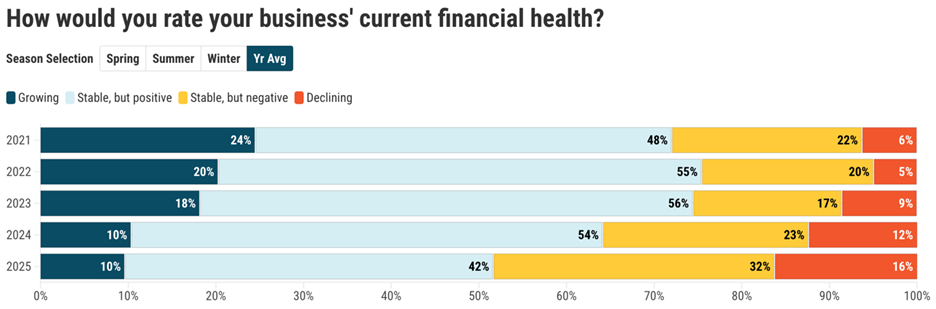
With wholesale price pressure and decreasing consumer demand, nearly half of hospitality businesses are now in some stage of financial decline. According to the report, 48.3% of operators indicated some stage of financial decline, an increase of 12 percentage points from 2024, reinforcing that this is a systemic issue rather than isolated underperformance.
“Financial pressure along with overregulation is fueling this dramatic decline,” said Angie Whitcomb, President & CEO of Hospitality Minnesota. “Minnesota lawmakers are at a clear crossroads: work with industry to create high-paying and quality jobs or witness increased business closures and layoffs.”
Businesses Pinched
Customer traffic and business profitability are declining for a majority of hospitality businesses, according to the report. In 2025, 57% of hospitality businesses reported lower profits, while 45% reported reduced customer traffic, a 21-point increase since 2024, signaling weakening demand alongside rising costs due to tariffs and lingering inflation.

From the Minneapolis Federal Reserve.
"With consumer pullbacks and wholesale prices increasing, businesses are expecting the worst - 54% of hospitality businesses expect lower profits. This winter alone, including January and February of this year, 67% of businesses reported expecting lower profits."
“These external factors are forcing our hospitality businesses to make hard choices.” said Angie Whitcomb, President & CEO of Hospitality Minnesota. “Limiting hours, sizing down workforce, or closing altogether are considerations and realities most hospitality businesses are already facing.”
Squeezed Industry
Costs are rising faster than revenues, squeezing already thin margins. Wholesale, labor, and tariff-driven costs are forcing difficult tradeoffs. The report shows 92% of businesses face wholesale price increases, while only 80% have raised prices. Leaving 12% of hospitality businesses to absorb higher costs rather than passing them on to customers, further eroding margins.
Despite relatively flat employment numbers (down 1,000 jobs statewide in 2025), wages are rising. Last year, total wages for the hospitality industry increased by roughly 4%, and weekly average wages rose to $535.67.
As revenue growth fails to keep pace with increasing overhead costs such as wholesale and wages – margin compression is getting worse. The hospitality industry operates on some of the tightest margins, and these external factors only worsen an already bleak outlook.
Regulation Impact
Cities with higher regulations are losing jobs and businesses, according to the report. Minneapolis and St. Paul experienced sharp slowdowns following labor cost increases, with Minneapolis losing 2,947 hospitality jobs and St. Paul losing 1,206, while suburban areas exceeded pre-COVID employment levels.
Higher local sales taxes also correlate with weaker recovery. Localities with combined sales tax rates of 1.25% or higher show recovery rates at 2–7% lower than other cities with smaller rates, indicating these local taxes are dampening growth, raising consumer prices, and limiting job creation.
“Our industry is not helpless, but we need policymakers to recognize the economic engine that is hospitality.” said Ms. Whitcomb. “Relaxing and reforming burdensome regulations which have proven costly is one way to reduce the margin squeeze for Minnesota’s hospitality industry.”
The report is pointing to three specific short-term solutions:
- Service Fees Restructuring: Federal regulations exempt restaurants and lodging sectors from service fee regulations. In Minnesota, exempting hospitality businesses would allow for increased flexibility in a volatile industry.
- Tip Pooling: Tip pooling reform would address a long-standing inequity between front-of-house and back-of-house staff.
- “Swipe Fee” Reform: Credit card interchange fees on the tax and tip portions of transactions cost Minnesota hospitality operators millions of dollars annually.
About Hospitality Minnesota
Hospitality Minnesota is a trade association that represents and advocates for businesses in Minnesota's hospitality industry, including restaurants, hotels, resorts, and other lodging and tourism-related enterprises. The organization works to support its members through advocacy, education, and business resources.